Friday, April 3, 2015

Ungraded Success Part 3

Grades are meaningless, yet teachers, students, and parents have been indoctrinated to expect and place undue weight on them as indicators of learning. As a teacher I have always wanted to throw out grades in my classroom but did not know how. Last year I attempted to incorporate grade substitution with extra feedback on journals that funneled into a graded assignment. This wasn't close enough.

Then last fall I had a brainstorm. I will attempt to create as close to a no-grades classroom as I can manage in the spring with my seniors in speech class. My rationale was this: speech class is really a coaching-style class, where students' learning is tied to their progress over time with practice and feedback. Okay, that's not different from much else in school…making it the perfect class to experiment with. Plus, these are second-semester seniors whose grades are no longer tied to class rank or valedictory selection. I decided to go for it and sent a letter home to parents inviting comments or questions, since most of them are also in the indoctrination pool.

I knew I needed student input, if not their initial buy-in (see my Part 1 post). So we discussed the qualities of an effective speaker and then I had students enter their thoughts into a google form which was converted into this spreadsheet. Then I had students color-code the form according to the kind of trait: smoothness, eye contact, and so on. We looked at the color-coding for frequency. You can see, for example, that the yellow trait, posture/movement, was named frequently. We knew that was an important trait to coach and assess in our speech class.


What about teacher guidance and expertise? I collaborated with students to create the rubric. For example, my experience as a speech teacher told me that I needed to assess some things they didn't mention, like practice. I took their input and put it into this form, which I call a "success rubric." I gave students a full week to comment on it, and we spent some class time talking about the language. One student wanted a "goals" section so we added that. 

After each speech, I have a conference with each student individually (while other students are working on another project) when we look at the rubric together and identify areas of strength and areas where students can grow. These conferences give me the opportunity to illuminate challenges students are facing, identify places I've seen progress, and help them set goals for their next speeches. These conferences are well worth the extra time they take.

Finally, you are probably wondering about the grades I am required to submit about every five weeks. If you look at the form, you'll see there are four columns of descriptors with no grades or numbers at the top of each column. Superimpose A, B, C, and D over these and you'll see how it works out. I hate this part of the process, because we still have to come down to a letter.

However, I do think students are starting to think less about those letters, and more about their own learning. I call this ungraded success.

Thursday, April 2, 2015

Ungraded Success Part 2

So it turns out we've been indoctrinated by grades. All of us. Yes, indoctrinated. Programmed. Brainwashed.

Let me put it like this: how many reasons can you find to tell me why a no-grades approach isn't practical? It's easy. Let's just count:

1) Grades motivate students.
2) Grades identify struggling students and academically ineligible students.
3) Grades are useful in ranking students for valedictorian, etc.
4) Grades are necessary for colleges deciding whom to accept.
5) Grades help us decide which students to promote and which to hold back.
6) Grades tell us what students have learned.

Why do we believe all this? For one, we've nearly all been raised this way. Some of us - me included, have defined ourselves by grades. Are you an A student? Did you get a four-point in school? Or are you the other kind, hounded by your parents (or not) and feeling like you might not make it through school after all?

I will confess that in my own house I am surrounded by discussions of grades. One child does not earn high marks but seems not to care, and the other child is nearly obsessed with earning high marks and actually identifies with the "smart kids" in order to fit in. I've always told them that I don't care what grades they get as long as they are learning, and as long as these grades are C's or above - because if not, then they're not learning. Wait, what?

Yep, I can't shake the grade philosophy out of my head either, even though I know intellectually - as I wrote yesterday - that grades are a superficial and intrinsically meaningless overlay of what's actually important: learning. As a parent I can't seem to remember this, although as a teacher I am getting it.

In my classroom, I have begun to make some progress. Read about my first steps into a no-grades classroom approach tomorrow.


Wednesday, April 1, 2015

Ungraded Success, Part 1


Ask most teachers what they dislike about their jobs, and they will tell you in the top three is grading. Why do we hate it? There are so many reasons: It's time-consuming. The kids don't look at the feedback. Grades are meaningless.

I'd like to explore this last one a bit. Grades are not intrinsically valuable. If they were, why wouldn't we just use grades and GPA to decide whether schools meet AYP? Well duh, they aren't standardized. If they aren't standardized, why do we use them to calculate GPA and all the things GPA indicates: class rank, college admissions, scholarships? At my school we also use it to determine eligibility for sports and extracurricular activities, entry to National Honor Society and the honors diploma program. So let's not pretend grades aren't used to rank, sort, order, and label students.

What relationship do grades have to learning? Imagine that you had a map of your town, and you also had a transparency with icons of cute dogs printed on it. There are many kinds of dogs - well, five, anyway. They are sprinkled over the transparency randomly. Now overlay your map with your transparency. What do you have? An underlying meaningful thing (a community) with an overlay of meaningless cute dogs. That's how grades are, lying on top of the very significant, and important, work of education. People look at a school and all they see are cute dogs, when in reality the most important thing that happens in a school is the education. And this is what it comes down to: education is not grades.

When I talked to my seniors about this recently, some of them fully agreed with me: grades do not motivate them, but they confessed they'd been slaves to grades for most of their years in school. Others agreed but were unaffected by the carrot-and-stick of grades, hence their low GPAs. Some kids disagreed and said that grades do motivate them to work harder. When I suggested a no-grades classroom, some students were instantly worried - the same ones who find grades a motivator. Most of the students, by the way, did not find this a titillating discussion. In other words, they have no idea (and don't really care) what kind of rebel their teacher is.

Tomorrow I'll talk more about the ways we (students, educators, parents) have been indoctrinated by grades.


Sunday, December 21, 2014

Ambassadors from Indian Country in Post-Ferguson America

I've spent a little time thinking about how and why Ferguson didn't seem to affect my students. They hardly recognized the name Michael Brown, and they didn't outwardly express many thoughts about what happened after the non-indictment. Given the demographics in Montana, perhaps this isn't surprising.

So when I saw all those tweets and blogs about how to talk to my students about race in a post-Ferguson classroom, I initially scrolled right on by.


Today I had a moment of clarity. I live and teach on the Flathead Indian Reservation. Montana is a state where the multicultural initiative called Indian Education for All is required by law, where all students are to be taught about Montana's first people in culturally responsive ways, where schools are encouraged to make partnerships with local tribes, and where Montana's commitment to preserving the distinct and unique heritage of our American Indian populations is encoded into our state constitution.

Yet despite the 42 years of this constitutional mandate and the 10 years of funded professional development and materials for IEFA, these are some of the ignorant things my students still hear when they leave their home for sporting events, visits to historical sites, or even shopping in our nearest small city:

How come you guys get money from the government?
You shouldn't be able to hunt all year round.
Do you all live in tepees and ride horses everywhere?
Go back to the rez!
Okay, chief…
And worst: Hey, prairie nigger!

You read that right.

Even here at home some of the very same ignorance is evident. There are signs at the boundaries of some nonIndians' property (erected by those property owners) proclaiming "You are now leaving the Flathead Indian Reservation: All Constitutional Rights Restored." Others complain about the hunting rules for tribal members, and there has been a long, very contentious negotiation of a water rights in which ranchers (primarily nonIndian) have been haggling with others over water provisions.

Ten Ambassadors talk to sixth graders at an elementary school in Missoula.

With all this treatment ranging from misinformation to malice in mind, I created a club this year called the Reservation Ambassadors. We are a large group of both Indian and nonIndian students, boys and girls, grades 9-12, committed to changing hearts and minds of other young people through building relationships with them. We believe that creating relationships will help dispel stereotypes because once you know people personally, it's harder to categorize and dismiss them. We work with small groups of students either face to face or through Skype, discussing things like stereotypes and misconceptions and answering lots of questions.

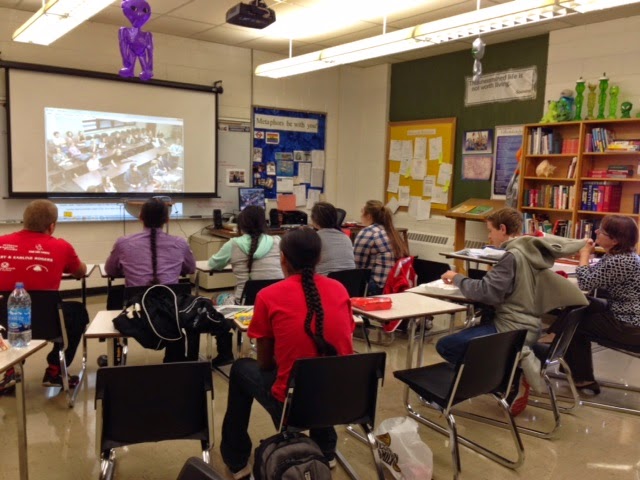
Some Ambassadors talk with kids in Chicago via Skype.

Abby Yocum helps a group of 8th graders in Kalispell understand the tribal constitution.

Ambassadors teamed up with 9th graders in Kalispell to discuss stereotypes in a story we all read.

This club is not that much fun. It's not exciting like pep club; it's not feel-good like National Honor Society; it's not creative like FCCLA. Students often have to read things like the tribal constitution or a short story before going to a school. They miss lunches to discuss tomorrow's plans. Often we have long bus rides and sometimes they don't get back in time for sports practice or work.


But this club, and these kids, are making a difference. Students and teachers we've met have expressed that they didn't know what to think about reservations, but now they have positive impressions. They feel like they're learning things, and that's what we're all about.

In 10 weeks our club has worked with six different off-reservation schools and spoken to over 230 students in grades 6-12. In nearly every case, another teacher or sometimes an administrator has stopped in to witness what we're doing. In nearly every case, the host teacher has asked us to come back or suggested an exchange where her students could come to the reservation. I think this is one of the most exciting parts of the partnerships: the potential for further relationship-building.


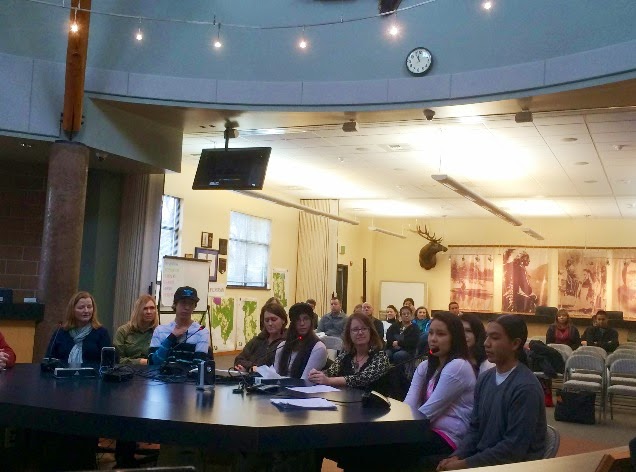
When we visited the Tribal Council last week, I could not have been more proud of my two student speakers. They expressed the importance of the club, why they joined and what they've done. They were praised by the council members for their maturity and commitment, and I could not agree more.

Senior Zach Felsman (far right) and freshman Laurencia Starblanket speak to Council members about our club.

Now when I hear about Ferguson and see suggestions of what could be done in classrooms to help prevent such outcomes in the future, I will think about the part the Reservation Ambassadors are playing in helping make our state a better community.


Saturday, December 13, 2014

TweetSpot

I love blogs. Teachers should blog, and I read a lot of great edublogs like Edushyster and Curmudgucation and ParentingTheCore. But I haven't been blogging much lately. I've been busy. What has been consuming my extra non-teacher time?

Mostly, it's twitter. I have been all about the twitter in the past couple of months. I want to tell you why.

First, for someone with the attention span of a sparrow, twitter is the best method of interacting with the world outside my living room. There is only so much facebook scrolling one can do, but reading the twitter feed, trying different search options, and finally reading blogs with the intention of tweeting them out is extremely satisfying both mentally and professionally. Plus I can keep my pajamas on.

Twitter, according to its teacher advocates, is one of the best sources of professional development available. You can follow people you like, participate in twitter chats, conduct searches of topics that interest you as an educator. You can publicize your ideas or your creations. You can promote your own students' work.


What do I do? All of that. I participate in the Sunday night #ECET2 chat (8 pm EST), the Tuesday night Montana Ed Chat #MTedchat (8 pm MST) and the Breakfast Club chat at 5:30 every morning (#BFC530). Through those, I joined voxer, a walkie-talkie style app on my phone where I get to listen and participate as we extend the #BFC530 topic. I also joined a book club on voxer; we are reading and discussing Thanks for the Feedback.

Do I sound a little sick? Well, consider this: twitter is so beneficial, I decided, that I initiated Twitter Jedi Training Week in my district. I started by asking everyone in the district to respond to a quick survey about whether they are on twitter or not, and are they interested in learning more. After that I set up a week of activities complete with prizes for participation. One day I had trainees participate in a scavenger hunt. Another day they set up an account and submitted their handle. I used a google form for each one of these participation calls.

Another day I showed them the power of the hashtag search; in advance, I sent out a call on twitter for people to welcome my Jedi Trainees from #arlee - so when my district participants searched #arlee they found an enormous collection of welcome messages from the twitterverse. It was awesome. See some of the responses here.


Thanks for reading this overdue blog about twitter. I'm just going to tie things up here, get another cup of coffee, edit and add links and images.

And then - pretend like you didn't see this coming - I'll tweet it out.

Saturday, November 15, 2014

Hey You! Go Make Some Change Happen!

What are you waiting for?

I mean you. You, Kindergarten teacher who's got your hands full with five-year-old needs and their sweet charms. You, elementary P.E. teacher whose jump-ropes keep going missing. You, eighth-grade science teacher who's got a love for biology you want so much to transmit.

You've all got wants, needs, and complaints about how things are. Maybe you dislike your schedule. Maybe your administrator is unresponsive. Maybe you oppose testing. Maybe you want to promote positivity amongst your staff but you don't know how.

Guess what? None of these challenges are going away by themselves. NONE OF THEM. Just like in your real life (the other, non-teaching one) there are parameters but mostly your happiness is up to you. You have to make the changes you wish to see in the world.

YOU ARE THE ONLY ONE WHO CAN DO IT.

I take my own advice to heart. I've been super inspired this year to do some of this in my own world (the teaching one). Let me share. First of all, I've been tweeting into the Breakfast Club daily twitter chat; it meets at 5:30 am and the hashtag is #BFC530 if you are so inclined to join. It gets me going EVERY MORNING.

One of the ideas I got during #BFC530 one day was to create a shout-out board. I made it with a twitter theme - here's a pic after just a few hours. Two weeks later, the board was filled with shout-outs.


First tweet ever in Salish? 

Another idea I conceived was the Reservation Ambassadors club, a club dedicated to building relationships with off-reservation schools in order to dispel misconceptions and stereotypes. The first meeting of this club drew 25% of the high school population. We quickly got moving to make connections with teachers and their classes. The photos below show our kids in action, working with these schools from different areas. We've based our work on shared videos and texts. When we can't get to a school due to distance, we skype!
Our master planning board!

Skyping with New Trier school in Chicago

Working directly with 6th graders at Target Range Elementary in Missoula

Guess what? I hate useless furniture and wasted classroom space! A long-time desire of mine to change my classroom is finally coming to fruition as I commission the shop class to demolish my counter (made possible by removal of desktop computers, made possible by adoption of chromebooks by the district). Moved the whiteboards, painted the wall, putting up bulletin boards...oh yeah! It's a work in progress. My final move will be to replace the desks with round tables, lamps and power strips.
Before, during, and ... after is coming!

I'm also not satisfied with my certifications. I want to be the BEST teacher I can be! So I've embarked on the journey to National Board Certification, which everyone says has made them more reflective and purposeful. I'm relying on my NBCT colleagues to push me along.

I can't do any of this alone - notice how all of the above require support from others? Yep, I try to remember that at all times. However, nobody but me initiated any of this. That's because I have the desire to do it...and who knows what else I'll decide to change in the coming years?


So: take some time right now to think about one thing you want to change. One thing you can change. One way to make your life better. One way to improve your world... and go do it.


Friday, November 7, 2014

Bringing It Back Home

We teachers love to attend good conferences. We swap ideas, weigh down our suitcases with free stuff from the vendors, and let's be honest: it's all about the local food. We get to say to our colleagues for years afterward, "Isn't this a cool lesson? I learned it at that conference in Philly!"


I just attended a conference in New Orleans without teaching workshops. Without vendors. Without poster presentations. And this was the most inspiring conference I've ever attended.There was singing and dancing at this conference - yes, I participated. There was a parade - yes, I participated. There were problem-solving, colleague circles, cage-busting, high-fives and shout-outs. Yes, I participated!  I did not want it to end. I looked for my colleagues on the plane. I sought them out on twitter with our hashtag (#ecet2nola). I've continued to interact with them since via facebook and voxer.

So here it is: ECET2 New Orleans. ECET2 stands for Elevating and Celebrating Effective Teaching and Teachers and the entire convening - that's what we call it, not a conference - was wholly focused on this task. Funded by the Gates Foundation, it elevated and celebrated our work every day. The staff and organizers did this. Dr. Irvin Scott, the Deputy Director for Effective Teaching, did this with daily calls to convene (and sing, and dance!) The attendees picked that ball right up and did it when we supported each other through colleague circles.

Sound hokey? Yeah, in the way an old-fashioned revival is hokey. Yeah, in the way a wedding is hokey. Yeah, in the way meeting the President is hokey. Not hokey! One hundred percent genuine, and you don't hear me gush like this often. ECET2 got it right, folks.

Here's a video about the convening, made during the convening.


Now why did I get to attend this incredible weekend in New Orleans? I was lucky enough to be selected as a keynote speaker for the "Cultivating a Calling" series. All the speakers in this series are teachers sharing our stories on stage. We rehearsed and supported each other throughout the weekend. Our stories are here: Anthony Marshall, Dwight Davis, Matthew Keefauver, and me.

Let's break this down. What do the ECET2 people want? Why did Gates pay for all these educators to travel and attend and eat at this conference? Because here it is: They want teachers like us to bring it back home. They believe that elevating and celebrating effective teaching and teachers will promote positive problem-solving, professionalism, and improved opportunities and outcomes for students. Because as every educator knows, a school's culture can have an enormous impact on all of those elements, which in turn affect student achievement. If educators do not promote and participate in this kind of positive, uplifting behavior, we will be impaired in our efforts to teach students effectively. That's the bottom line.

So what happens next? What happens is I keep in touch with my #ECET2 pals. I help plan a Western Montana ECET2 convening. I get the sound system ready. I invite teachers to speak. I practice my shout out voice. Because that's what we do: we lift each other up, we celebrate our successes, and we plan for more.

And for the record, it really is all about the food, y'all.