There is a popular meme depicting the vast differences between some areas of our society from 80 or 100 years ago to today: think hospitals, cities, transportation, communication. Now place those unbelievable transformations in stark contrast to today's classrooms.
Aside from the apparently immobility of the classroom setup, we are stuck in so many detrimental and regressive models in our education system. To wit: the assembly line of K-12, where students move helplessly along, collecting parts (credits) until they reach the end when they are "complete"; the grading system which does nothing but overlay meaningless letters on top of learning in order to indicate student worth to parents, counselors, outsiders and the students themselves; the intransigence of some school systems to flex with student needs; the commercialization of districts and the hijacking of teacher prerogative by massive corporate entities.
Our education system, based as it has been on efficiency and factory style movement through grades and curricula, is ill-equipped to shepherd future leaders, businessmen and women, teachers, and laborers into the twenty-first century. To move the American education system forward, I advocate an entire paradigm shift from the factory model to a collaborative, skills-based model.
This new approach is reflected in everything from pedagogy to text selection to the way the school day is structured to financing of school systems and the hierarchical structures within schools. I wrote about my ideas in detail in another post.
But what can regular teachers do? We can't change school budget processes or reorganize the teachers in our buildings. We can't turn away high-powered sponsors or high-stakes tests. We control one thing only: our classrooms. So let's start there.
I replaced my desks (which were in pods anyway) with round tables and rolling chairs. I even procured a tall table for students who tire of sitting. I created a reading nook with inexpensive bean bag chairs and a rug for comfort. These aren't new ideas, but they do require rethinking instruction.
For one, round tables with lamps are not conducive to a teacher lecturing for long. They are conducive to chatter and collaboration. For another, a teacher has to build in the time for reading or individual work in a comfortable chair. The directive shouldn't be "there are 9 minutes left in class and I'm not sure what to do - so grab a bean bag and read!"
In other words, our pedagogy has to change. As Fisher and Frey note in Literacy 2.0, our culture's paradigm is changing from one of competition to one of collaboration. As Wagner reports in The Global Achievement Gap, business leaders are looking for employees who can think creatively, design collaboratively, and work efficiently. Even the popular film The Internship clearly relays this shift, as two older, unemployed buddies vie against young whippersnappers for a position at Google. (The unexpected ending does not change this focus on creative thinking and collaboration!)
In short, teachers must start thinking about new ways to reach students. We need to build our lessons with a creative spirit and a skills-based focus, without giving up the content we love so much that we wanted to share it with others. We can consider how to let go of an archaic and meaningless grading system. We need to redesign our classrooms and rethink our management strategies.
Take a look around your classrooms when you return to school and ask yourselves this question: what must go?
Sunday, April 5, 2015
Saturday, April 4, 2015
April 4 Reflections: Be More, In This Life
Most English teachers I know really appreciate a good story: plot that wraps you up like a tight blanket and doesn't let you go all night. Characters that feel like your best friend or your most hated enemy. Cliffhangers that make you glad it's not your life, really.
As it turns out, I like these stories as much as the next guy, but I don't love teaching about them. I find myself much more inspired by nonfiction.
A favorite lesson revolves around this verse in "Pride" by U2 and the accompanying photo:
Early morning, April four
Shot rings out in the Memphis sky
Free at last, they took your life
They could not take your pride
We investigate the way art, or popular culture, reflects historical and contemporary events, bringing to life the events of that tragic day.
Another favorite activity of mine is to show students the film Malcolm X and discuss personal choices and redemption. I love the way the film chronicles Malcolm's transformations, his initial embodiment of his troubled youth and eventual rejection of his destructive habits and beliefs. Every time I watch the assassination scene I weep along with Angela Bassett. At the end, I get the opportunity to teach a little about Nelson Mandela, as he appears in the final scene of the film.
How about this story of commitment and redemption? My online students in Native American Studies spend the whole semester learning about various tribes and the resilience they've shown in the face of federal policies and individual acts aimed at assimilation and cultural erasure. Then I ask them to watch Dakota 38, a 78-minute film about men and women who make a horseback journey every year to remember the Dakotas hanged at Mankato, Minnesota. This gives an incredible opportunity to reflect on the implications of history, resilience, and the significance of cultural continuity.
So on this April 4, I'd like to celebrate my non-fiction heroes: real people inspiring us to be more, in this life.
As it turns out, I like these stories as much as the next guy, but I don't love teaching about them. I find myself much more inspired by nonfiction.
A favorite lesson revolves around this verse in "Pride" by U2 and the accompanying photo:
Early morning, April four
Shot rings out in the Memphis sky
Free at last, they took your life
They could not take your pride
We investigate the way art, or popular culture, reflects historical and contemporary events, bringing to life the events of that tragic day.
Another favorite activity of mine is to show students the film Malcolm X and discuss personal choices and redemption. I love the way the film chronicles Malcolm's transformations, his initial embodiment of his troubled youth and eventual rejection of his destructive habits and beliefs. Every time I watch the assassination scene I weep along with Angela Bassett. At the end, I get the opportunity to teach a little about Nelson Mandela, as he appears in the final scene of the film.
How about this story of commitment and redemption? My online students in Native American Studies spend the whole semester learning about various tribes and the resilience they've shown in the face of federal policies and individual acts aimed at assimilation and cultural erasure. Then I ask them to watch Dakota 38, a 78-minute film about men and women who make a horseback journey every year to remember the Dakotas hanged at Mankato, Minnesota. This gives an incredible opportunity to reflect on the implications of history, resilience, and the significance of cultural continuity.
So on this April 4, I'd like to celebrate my non-fiction heroes: real people inspiring us to be more, in this life.
Friday, April 3, 2015
Ungraded Success Part 3
Grades are meaningless, yet teachers, students, and parents have been indoctrinated to expect and place undue weight on them as indicators of learning. As a teacher I have always wanted to throw out grades in my classroom but did not know how. Last year I attempted to incorporate grade substitution with extra feedback on journals that funneled into a graded assignment. This wasn't close enough.
Then last fall I had a brainstorm. I will attempt to create as close to a no-grades classroom as I can manage in the spring with my seniors in speech class. My rationale was this: speech class is really a coaching-style class, where students' learning is tied to their progress over time with practice and feedback. Okay, that's not different from much else in school…making it the perfect class to experiment with. Plus, these are second-semester seniors whose grades are no longer tied to class rank or valedictory selection. I decided to go for it and sent a letter home to parents inviting comments or questions, since most of them are also in the indoctrination pool.
I knew I needed student input, if not their initial buy-in (see my Part 1 post). So we discussed the qualities of an effective speaker and then I had students enter their thoughts into a google form which was converted into this spreadsheet. Then I had students color-code the form according to the kind of trait: smoothness, eye contact, and so on. We looked at the color-coding for frequency. You can see, for example, that the yellow trait, posture/movement, was named frequently. We knew that was an important trait to coach and assess in our speech class.
Then last fall I had a brainstorm. I will attempt to create as close to a no-grades classroom as I can manage in the spring with my seniors in speech class. My rationale was this: speech class is really a coaching-style class, where students' learning is tied to their progress over time with practice and feedback. Okay, that's not different from much else in school…making it the perfect class to experiment with. Plus, these are second-semester seniors whose grades are no longer tied to class rank or valedictory selection. I decided to go for it and sent a letter home to parents inviting comments or questions, since most of them are also in the indoctrination pool.
I knew I needed student input, if not their initial buy-in (see my Part 1 post). So we discussed the qualities of an effective speaker and then I had students enter their thoughts into a google form which was converted into this spreadsheet. Then I had students color-code the form according to the kind of trait: smoothness, eye contact, and so on. We looked at the color-coding for frequency. You can see, for example, that the yellow trait, posture/movement, was named frequently. We knew that was an important trait to coach and assess in our speech class.
What about teacher guidance and expertise? I
collaborated with students to create the rubric. For example, my experience as
a speech teacher told me that I needed to assess some things they didn't
mention, like practice. I took their input and put it into this form, which I call a "success rubric."
I gave students a full week to comment on it, and we spent some class time
talking about the language. One student wanted a "goals" section so we added that.
After each speech, I have a conference with each
student individually (while other students are working on another project)
when we look at the rubric together and identify areas of strength and areas
where students can grow. These conferences give me the opportunity to
illuminate challenges students are facing, identify places I've seen progress,
and help them set goals for their next speeches. These conferences are well
worth the extra time they take.
Finally, you are probably wondering about the
grades I am required to submit about every five weeks. If you look at the form,
you'll see there are four columns of descriptors with no grades or numbers at
the top of each column. Superimpose A, B, C, and D over these and you'll see
how it works out. I hate this part of the process, because we still have to
come down to a letter.
However, I do think students are starting to think less about those letters, and more about their own learning. I call this ungraded success.
Thursday, April 2, 2015
Ungraded Success Part 2
So it turns out we've been indoctrinated by grades. All of us. Yes, indoctrinated. Programmed. Brainwashed.
Let me put it like this: how many reasons can you find to tell me why a no-grades approach isn't practical? It's easy. Let's just count:
1) Grades motivate students.
2) Grades identify struggling students and academically ineligible students.
3) Grades are useful in ranking students for valedictorian, etc.
4) Grades are necessary for colleges deciding whom to accept.
5) Grades help us decide which students to promote and which to hold back.
6) Grades tell us what students have learned.
Why do we believe all this? For one, we've nearly all been raised this way. Some of us - me included, have defined ourselves by grades. Are you an A student? Did you get a four-point in school? Or are you the other kind, hounded by your parents (or not) and feeling like you might not make it through school after all?
I will confess that in my own house I am surrounded by discussions of grades. One child does not earn high marks but seems not to care, and the other child is nearly obsessed with earning high marks and actually identifies with the "smart kids" in order to fit in. I've always told them that I don't care what grades they get as long as they are learning, and as long as these grades are C's or above - because if not, then they're not learning. Wait, what?
Yep, I can't shake the grade philosophy out of my head either, even though I know intellectually - as I wrote yesterday - that grades are a superficial and intrinsically meaningless overlay of what's actually important: learning. As a parent I can't seem to remember this, although as a teacher I am getting it.
In my classroom, I have begun to make some progress. Read about my first steps into a no-grades classroom approach tomorrow.
Let me put it like this: how many reasons can you find to tell me why a no-grades approach isn't practical? It's easy. Let's just count:
1) Grades motivate students.
2) Grades identify struggling students and academically ineligible students.
3) Grades are useful in ranking students for valedictorian, etc.
4) Grades are necessary for colleges deciding whom to accept.
5) Grades help us decide which students to promote and which to hold back.
6) Grades tell us what students have learned.
Why do we believe all this? For one, we've nearly all been raised this way. Some of us - me included, have defined ourselves by grades. Are you an A student? Did you get a four-point in school? Or are you the other kind, hounded by your parents (or not) and feeling like you might not make it through school after all?
I will confess that in my own house I am surrounded by discussions of grades. One child does not earn high marks but seems not to care, and the other child is nearly obsessed with earning high marks and actually identifies with the "smart kids" in order to fit in. I've always told them that I don't care what grades they get as long as they are learning, and as long as these grades are C's or above - because if not, then they're not learning. Wait, what?
Yep, I can't shake the grade philosophy out of my head either, even though I know intellectually - as I wrote yesterday - that grades are a superficial and intrinsically meaningless overlay of what's actually important: learning. As a parent I can't seem to remember this, although as a teacher I am getting it.
In my classroom, I have begun to make some progress. Read about my first steps into a no-grades classroom approach tomorrow.
Wednesday, April 1, 2015
Ungraded Success, Part 1
Ask most teachers what they dislike about their jobs, and they will tell you in the top three is grading. Why do we hate it? There are so many reasons: It's time-consuming. The kids don't look at the feedback. Grades are meaningless.
I'd like to explore this last one a bit. Grades are not intrinsically valuable. If they were, why wouldn't we just use grades and GPA to decide whether schools meet AYP? Well duh, they aren't standardized. If they aren't standardized, why do we use them to calculate GPA and all the things GPA indicates: class rank, college admissions, scholarships? At my school we also use it to determine eligibility for sports and extracurricular activities, entry to National Honor Society and the honors diploma program. So let's not pretend grades aren't used to rank, sort, order, and label students.
What relationship do grades have to learning? Imagine that you had a map of your town, and you also had a transparency with icons of cute dogs printed on it. There are many kinds of dogs - well, five, anyway. They are sprinkled over the transparency randomly. Now overlay your map with your transparency. What do you have? An underlying meaningful thing (a community) with an overlay of meaningless cute dogs. That's how grades are, lying on top of the very significant, and important, work of education. People look at a school and all they see are cute dogs, when in reality the most important thing that happens in a school is the education. And this is what it comes down to: education is not grades.
When I talked to my seniors about this recently, some of them fully agreed with me: grades do not motivate them, but they confessed they'd been slaves to grades for most of their years in school. Others agreed but were unaffected by the carrot-and-stick of grades, hence their low GPAs. Some kids disagreed and said that grades do motivate them to work harder. When I suggested a no-grades classroom, some students were instantly worried - the same ones who find grades a motivator. Most of the students, by the way, did not find this a titillating discussion. In other words, they have no idea (and don't really care) what kind of rebel their teacher is.
Tomorrow I'll talk more about the ways we (students, educators, parents) have been indoctrinated by grades.
Sunday, December 21, 2014
Ambassadors from Indian Country in Post-Ferguson America
I've spent a little time thinking about how and why Ferguson didn't seem to affect my students. They hardly recognized the name Michael Brown, and they didn't outwardly express many thoughts about what happened after the non-indictment. Given the demographics in Montana, perhaps this isn't surprising.
So when I saw all those tweets and blogs about how to talk to my students about race in a post-Ferguson classroom, I initially scrolled right on by.
Today I had a moment of clarity. I live and teach on the Flathead Indian Reservation. Montana is a state where the multicultural initiative called Indian Education for All is required by law, where all students are to be taught about Montana's first people in culturally responsive ways, where schools are encouraged to make partnerships with local tribes, and where Montana's commitment to preserving the distinct and unique heritage of our American Indian populations is encoded into our state constitution.
Yet despite the 42 years of this constitutional mandate and the 10 years of funded professional development and materials for IEFA, these are some of the ignorant things my students still hear when they leave their home for sporting events, visits to historical sites, or even shopping in our nearest small city:
How come you guys get money from the government?
You shouldn't be able to hunt all year round.
Do you all live in tepees and ride horses everywhere?
Go back to the rez!
Okay, chief…
And worst: Hey, prairie nigger!
You read that right.
Even here at home some of the very same ignorance is evident. There are signs at the boundaries of some nonIndians' property (erected by those property owners) proclaiming "You are now leaving the Flathead Indian Reservation: All Constitutional Rights Restored." Others complain about the hunting rules for tribal members, and there has been a long, very contentious negotiation of a water rights in which ranchers (primarily nonIndian) have been haggling with others over water provisions.
With all this treatment ranging from misinformation to malice in mind, I created a club this year called the Reservation Ambassadors. We are a large group of both Indian and nonIndian students, boys and girls, grades 9-12, committed to changing hearts and minds of other young people through building relationships with them. We believe that creating relationships will help dispel stereotypes because once you know people personally, it's harder to categorize and dismiss them. We work with small groups of students either face to face or through Skype, discussing things like stereotypes and misconceptions and answering lots of questions.
This club is not that much fun. It's not exciting like pep club; it's not feel-good like National Honor Society; it's not creative like FCCLA. Students often have to read things like the tribal constitution or a short story before going to a school. They miss lunches to discuss tomorrow's plans. Often we have long bus rides and sometimes they don't get back in time for sports practice or work.
But this club, and these kids, are making a difference. Students and teachers we've met have expressed that they didn't know what to think about reservations, but now they have positive impressions. They feel like they're learning things, and that's what we're all about.
In 10 weeks our club has worked with six different off-reservation schools and spoken to over 230 students in grades 6-12. In nearly every case, another teacher or sometimes an administrator has stopped in to witness what we're doing. In nearly every case, the host teacher has asked us to come back or suggested an exchange where her students could come to the reservation. I think this is one of the most exciting parts of the partnerships: the potential for further relationship-building.
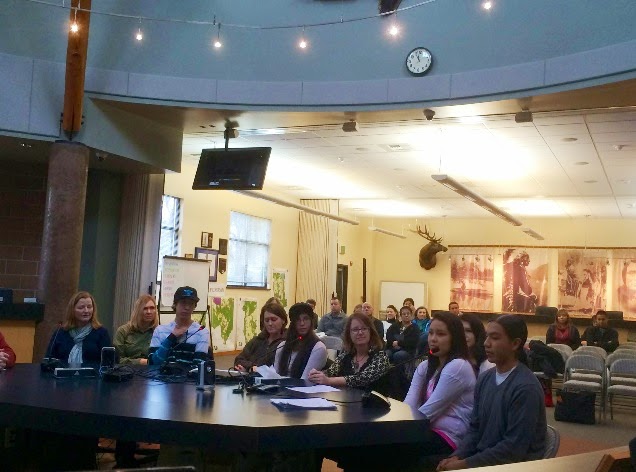
When we visited the Tribal Council last week, I could not have been more proud of my two student speakers. They expressed the importance of the club, why they joined and what they've done. They were praised by the council members for their maturity and commitment, and I could not agree more.
Now when I hear about Ferguson and see suggestions of what could be done in classrooms to help prevent such outcomes in the future, I will think about the part the Reservation Ambassadors are playing in helping make our state a better community.
So when I saw all those tweets and blogs about how to talk to my students about race in a post-Ferguson classroom, I initially scrolled right on by.
Today I had a moment of clarity. I live and teach on the Flathead Indian Reservation. Montana is a state where the multicultural initiative called Indian Education for All is required by law, where all students are to be taught about Montana's first people in culturally responsive ways, where schools are encouraged to make partnerships with local tribes, and where Montana's commitment to preserving the distinct and unique heritage of our American Indian populations is encoded into our state constitution.
Yet despite the 42 years of this constitutional mandate and the 10 years of funded professional development and materials for IEFA, these are some of the ignorant things my students still hear when they leave their home for sporting events, visits to historical sites, or even shopping in our nearest small city:
How come you guys get money from the government?
You shouldn't be able to hunt all year round.
Do you all live in tepees and ride horses everywhere?
Go back to the rez!
Okay, chief…
And worst: Hey, prairie nigger!
You read that right.
Even here at home some of the very same ignorance is evident. There are signs at the boundaries of some nonIndians' property (erected by those property owners) proclaiming "You are now leaving the Flathead Indian Reservation: All Constitutional Rights Restored." Others complain about the hunting rules for tribal members, and there has been a long, very contentious negotiation of a water rights in which ranchers (primarily nonIndian) have been haggling with others over water provisions.
Ten Ambassadors talk to sixth graders at an elementary school in Missoula.
With all this treatment ranging from misinformation to malice in mind, I created a club this year called the Reservation Ambassadors. We are a large group of both Indian and nonIndian students, boys and girls, grades 9-12, committed to changing hearts and minds of other young people through building relationships with them. We believe that creating relationships will help dispel stereotypes because once you know people personally, it's harder to categorize and dismiss them. We work with small groups of students either face to face or through Skype, discussing things like stereotypes and misconceptions and answering lots of questions.
Some Ambassadors talk with kids in Chicago via Skype.
Abby Yocum helps a group of 8th graders in Kalispell understand the tribal constitution.
Ambassadors teamed up with 9th graders in Kalispell to discuss stereotypes in a story we all read.
This club is not that much fun. It's not exciting like pep club; it's not feel-good like National Honor Society; it's not creative like FCCLA. Students often have to read things like the tribal constitution or a short story before going to a school. They miss lunches to discuss tomorrow's plans. Often we have long bus rides and sometimes they don't get back in time for sports practice or work.
But this club, and these kids, are making a difference. Students and teachers we've met have expressed that they didn't know what to think about reservations, but now they have positive impressions. They feel like they're learning things, and that's what we're all about.
In 10 weeks our club has worked with six different off-reservation schools and spoken to over 230 students in grades 6-12. In nearly every case, another teacher or sometimes an administrator has stopped in to witness what we're doing. In nearly every case, the host teacher has asked us to come back or suggested an exchange where her students could come to the reservation. I think this is one of the most exciting parts of the partnerships: the potential for further relationship-building.
When we visited the Tribal Council last week, I could not have been more proud of my two student speakers. They expressed the importance of the club, why they joined and what they've done. They were praised by the council members for their maturity and commitment, and I could not agree more.
Senior Zach Felsman (far right) and freshman Laurencia Starblanket speak to Council members about our club.
Now when I hear about Ferguson and see suggestions of what could be done in classrooms to help prevent such outcomes in the future, I will think about the part the Reservation Ambassadors are playing in helping make our state a better community.
Saturday, December 13, 2014
TweetSpot
I love blogs. Teachers should blog, and I read a lot of great edublogs like Edushyster and Curmudgucation and ParentingTheCore. But I haven't been blogging much lately. I've been busy. What has been consuming my extra non-teacher time?
Mostly, it's twitter. I have been all about the twitter in the past couple of months. I want to tell you why.
First, for someone with the attention span of a sparrow, twitter is the best method of interacting with the world outside my living room. There is only so much facebook scrolling one can do, but reading the twitter feed, trying different search options, and finally reading blogs with the intention of tweeting them out is extremely satisfying both mentally and professionally. Plus I can keep my pajamas on.
Twitter, according to its teacher advocates, is one of the best sources of professional development available. You can follow people you like, participate in twitter chats, conduct searches of topics that interest you as an educator. You can publicize your ideas or your creations. You can promote your own students' work.
What do I do? All of that. I participate in the Sunday night #ECET2 chat (8 pm EST), the Tuesday night Montana Ed Chat #MTedchat (8 pm MST) and the Breakfast Club chat at 5:30 every morning (#BFC530). Through those, I joined voxer, a walkie-talkie style app on my phone where I get to listen and participate as we extend the #BFC530 topic. I also joined a book club on voxer; we are reading and discussing Thanks for the Feedback.
Do I sound a little sick? Well, consider this: twitter is so beneficial, I decided, that I initiated Twitter Jedi Training Week in my district. I started by asking everyone in the district to respond to a quick survey about whether they are on twitter or not, and are they interested in learning more. After that I set up a week of activities complete with prizes for participation. One day I had trainees participate in a scavenger hunt. Another day they set up an account and submitted their handle. I used a google form for each one of these participation calls.
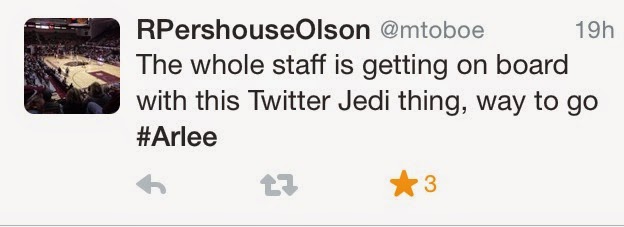
Another day I showed them the power of the hashtag search; in advance, I sent out a call on twitter for people to welcome my Jedi Trainees from #arlee - so when my district participants searched #arlee they found an enormous collection of welcome messages from the twitterverse. It was awesome. See some of the responses here.
Thanks for reading this overdue blog about twitter. I'm just going to tie things up here, get another cup of coffee, edit and add links and images.
And then - pretend like you didn't see this coming - I'll tweet it out.
Mostly, it's twitter. I have been all about the twitter in the past couple of months. I want to tell you why.
First, for someone with the attention span of a sparrow, twitter is the best method of interacting with the world outside my living room. There is only so much facebook scrolling one can do, but reading the twitter feed, trying different search options, and finally reading blogs with the intention of tweeting them out is extremely satisfying both mentally and professionally. Plus I can keep my pajamas on.
Twitter, according to its teacher advocates, is one of the best sources of professional development available. You can follow people you like, participate in twitter chats, conduct searches of topics that interest you as an educator. You can publicize your ideas or your creations. You can promote your own students' work.
What do I do? All of that. I participate in the Sunday night #ECET2 chat (8 pm EST), the Tuesday night Montana Ed Chat #MTedchat (8 pm MST) and the Breakfast Club chat at 5:30 every morning (#BFC530). Through those, I joined voxer, a walkie-talkie style app on my phone where I get to listen and participate as we extend the #BFC530 topic. I also joined a book club on voxer; we are reading and discussing Thanks for the Feedback.
Do I sound a little sick? Well, consider this: twitter is so beneficial, I decided, that I initiated Twitter Jedi Training Week in my district. I started by asking everyone in the district to respond to a quick survey about whether they are on twitter or not, and are they interested in learning more. After that I set up a week of activities complete with prizes for participation. One day I had trainees participate in a scavenger hunt. Another day they set up an account and submitted their handle. I used a google form for each one of these participation calls.
Another day I showed them the power of the hashtag search; in advance, I sent out a call on twitter for people to welcome my Jedi Trainees from #arlee - so when my district participants searched #arlee they found an enormous collection of welcome messages from the twitterverse. It was awesome. See some of the responses here.
And then - pretend like you didn't see this coming - I'll tweet it out.
Subscribe to:
Posts (Atom)